
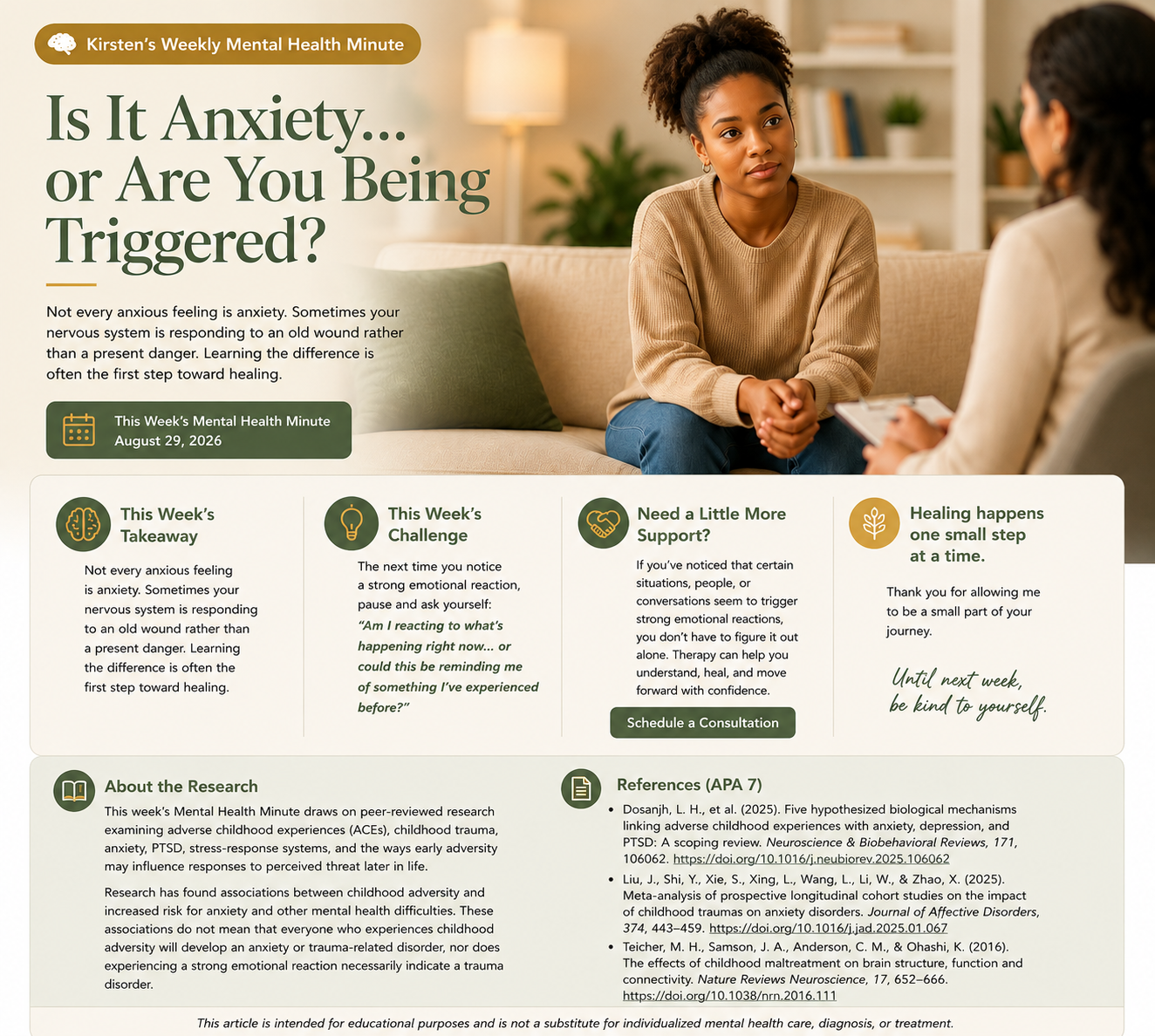
Kirsten’s Weekly Mental Health Minute
One of the questions I hear most often in my office is:
“Why do I have so much anxiety?”
Sometimes the answer really is anxiety. But sometimes what feels like anxiety may actually be a triggered response—or the two may be happening together. Understanding the difference can change the way you view yourself—and your healing.
Anxiety vs Trauma Response: What’s the Difference?
Anxiety often involves worry, fear, or uneasiness about something that might happen in the future. A triggered response can begin when a present-day cue reminds the brain and body of a painful or frightening past experience. Both can include a racing heart, tension, fear, or an urge to escape, and they can overlap. The pattern, context, and what happened just before the reaction may offer clues, but this article cannot diagnose what you are experiencing.
So, What’s the Difference?
Anxiety is often a general feeling of worry, fear, or uneasiness about something that might happen in the future.
You might worry about:
- An upcoming presentation.
- Your finances.
- Your health.
- Whether people like you.
- Something going wrong.
Triggers can feel different, although the physical sensations may look similar.
An emotional trigger can be a reminder that causes the brain and body to respond in connection with a past painful experience. The reminder may happen so quickly that you do not immediately realize what is happening.
It might be:
- A certain tone of voice.
- Someone ignoring your text.
- A look on someone’s face.
- Feeling criticized.
- Conflict.
- Rejection.
Suddenly your heart races. Your stomach tightens. You want to leave. Or you become defensive.
In that moment, your body may be responding not only to the present situation, but also to something it has learned from the past. That does not make anxiety and triggered responses mutually exclusive. A trigger can bring up anxiety, and someone who experiences anxiety can also be triggered.
Where Do Triggers Come From?
Our brains are designed to protect us.
When we experience painful or frightening events, the brain may learn to recognize situations that seem similar so it can respond quickly in the future. This can be adaptive.
One accessible way to think about it is that the brain can become “too good” at recognizing danger. That phrase is a metaphor—not a literal scientific conclusion—but it can help explain why a reaction sometimes feels much bigger or faster than the present moment seems to call for.
Research has found associations between adverse childhood experiences (ACEs)—which can include neglect, abuse, chronic criticism, bullying, or growing up in an unpredictable home—and increased risk for anxiety and other mental health difficulties later in life. An association is not a guarantee, and early adversity does not explain every strong emotional response.
Your Brain Isn’t Trying to Hurt You
It’s trying to protect you.
Imagine, as an illustrative example, a child who grows up in a home where yelling often predicts punishment or emotional pain.
Years later, that person may feel intense fear when someone raises their voice—even when the current situation is different or safer.
Their nervous system may have learned:
“Raised voices mean danger.”
This example is not a diagnosis, and it will not fit everyone’s experience. It simply illustrates one way the past may influence a present-day response.
Why Childhood Experiences Matter
Childhood is one of the times when our brains and bodies are learning an important question:
“Is the world safe?”
When children repeatedly experience unpredictability, criticism, rejection, emotional neglect, abuse, or household conflict, they may become more alert to possible danger. Research has linked childhood adversity with increased risk for later anxiety and trauma-related difficulties, while also showing that outcomes vary widely.
This does not mean everyone who experiences childhood adversity will develop anxiety or trauma-related symptoms. Many people are resilient. It also does not mean that being triggered proves you have PTSD, C-PTSD, or another trauma disorder. Strong emotional reactions can have many possible explanations.
The Good News
Our brains continue to change throughout life. This ability is often described as neuroplasticity.
Just as the brain can learn to watch for danger, it may also learn new experiences of safety over time. With appropriate support and practice, people may become better able to notice patterns, understand what activates a response, and choose ways of responding that feel more grounded.
That process is different for everyone. It is not a promise that triggers will disappear, and healing rarely follows a straight line. But change and learning can remain possible.
This Week’s Takeaway
Not every anxious feeling has the same source.
Sometimes you may be worrying about what could happen. Sometimes your nervous system may be responding to a reminder of something painful from the past. And sometimes both may be happening together.
Learning to notice the difference with curiosity—not judgment—can be a meaningful step toward healing.
This Week’s Challenge
The next time you notice a strong emotional reaction, pause—if it feels safe to do so—and ask yourself:
“Am I reacting to what’s happening right now… or could this be reminding me of something I’ve experienced before?”
You might also notice what happened just before the reaction, what you felt in your body, and what your mind predicted would happen next.
Simply becoming curious, without judging yourself, can be a powerful first step.
Frequently Asked Questions About Anxiety and Triggers
How can I tell if I’m anxious or being triggered?
Anxiety often centers on uncertainty or something that might happen, while a triggered response may follow a specific cue that connects with a painful past experience. The two can overlap and can feel similar in the body. Looking at the timing, context, and pattern of your reactions may be helpful, but a single reaction is not enough to diagnose yourself.
Can a trauma trigger feel like anxiety?
Yes. A triggered response may include fear, worry, muscle tension, a racing heart, stomach discomfort, defensiveness, or an urge to leave—sensations that can also occur with anxiety. That overlap is one reason it may take time and support to understand what you are experiencing.
Does being triggered mean I have PTSD?
No. People can have strong reactions to reminders without meeting criteria for PTSD or another trauma disorder. Only a qualified clinician can assess a diagnosis, and being triggered by itself does not prove one.
When should I talk to a therapist about anxiety or triggers?
Consider talking with a therapist if reactions are persistent, distressing, difficult to understand, or interfering with relationships, work, sleep, self-care, or daily life. You might explore counseling for anxiety, learn more about EMDR therapy in Frisco, TX, or discuss other approaches that fit your needs. A therapist can help you explore patterns without assuming a diagnosis.
For more practical, compassionate mental health education, visit the Mental Health Minute Blog.
Need a Little More Support?
If you’ve noticed that certain situations, people, or conversations seem to bring up strong emotional reactions, you do not have to figure it out alone.
Therapy can offer a supportive place to understand patterns, recognize possible triggers, and practice ways of responding that feel healthier and more grounded.
At Mind Wellness Therapy & Counseling, we provide compassionate counseling for adults experiencing anxiety, trauma-related concerns, PTSD, grief, and other emotional challenges. We offer in-person therapy in Frisco, Texas, as well as secure online therapy for clients throughout Texas.
If you’re ready to begin that journey, I’d be honored to walk alongside you.
Healing doesn’t happen all at once.
It happens one small step at a time.
Thank you for allowing me to be a small part of your journey.
Until next week, be kind to yourself.
About the Research
This week’s Mental Health Minute draws on peer-reviewed research examining adverse childhood experiences (ACEs), childhood trauma, anxiety, PTSD, stress-response systems, and ways early adversity may influence responses to perceived threat later in life.
Research has found associations between childhood adversity and increased risk for anxiety and other mental health difficulties. These associations do not mean everyone who experiences childhood adversity will develop an anxiety or trauma-related disorder, nor does experiencing a strong emotional reaction necessarily indicate a trauma disorder.
References
Dosanjh, L. H., Lauby, S., Fuentes, J., Castro, Y., Conway, F. N., Champagne, F. A., Franklin, C., & Goosby, B. (2025). Five hypothesized biological mechanisms linking adverse childhood experiences with anxiety, depression, and PTSD: A scoping review. Neuroscience & Biobehavioral Reviews, 171, 106062. https://doi.org/10.1016/j.neubiorev.2025.106062
Liu, J., Shi, Y., Xie, S., Xing, L., Wang, L., Li, W., & Zhao, X. (2025). Meta-analysis of prospective longitudinal cohort studies on the impact of childhood traumas on anxiety disorders. Journal of Affective Disorders, 374, 443–459. https://doi.org/10.1016/j.jad.2025.01.067
Teicher, M. H., Samson, J. A., Anderson, C. M., & Ohashi, K. (2016). The effects of childhood maltreatment on brain structure, function and connectivity. Nature Reviews Neuroscience, 17, 652–666. https://doi.org/10.1038/nrn.2016.111
This article is intended for educational purposes and is not a substitute for individualized mental health care, diagnosis, or treatment.