
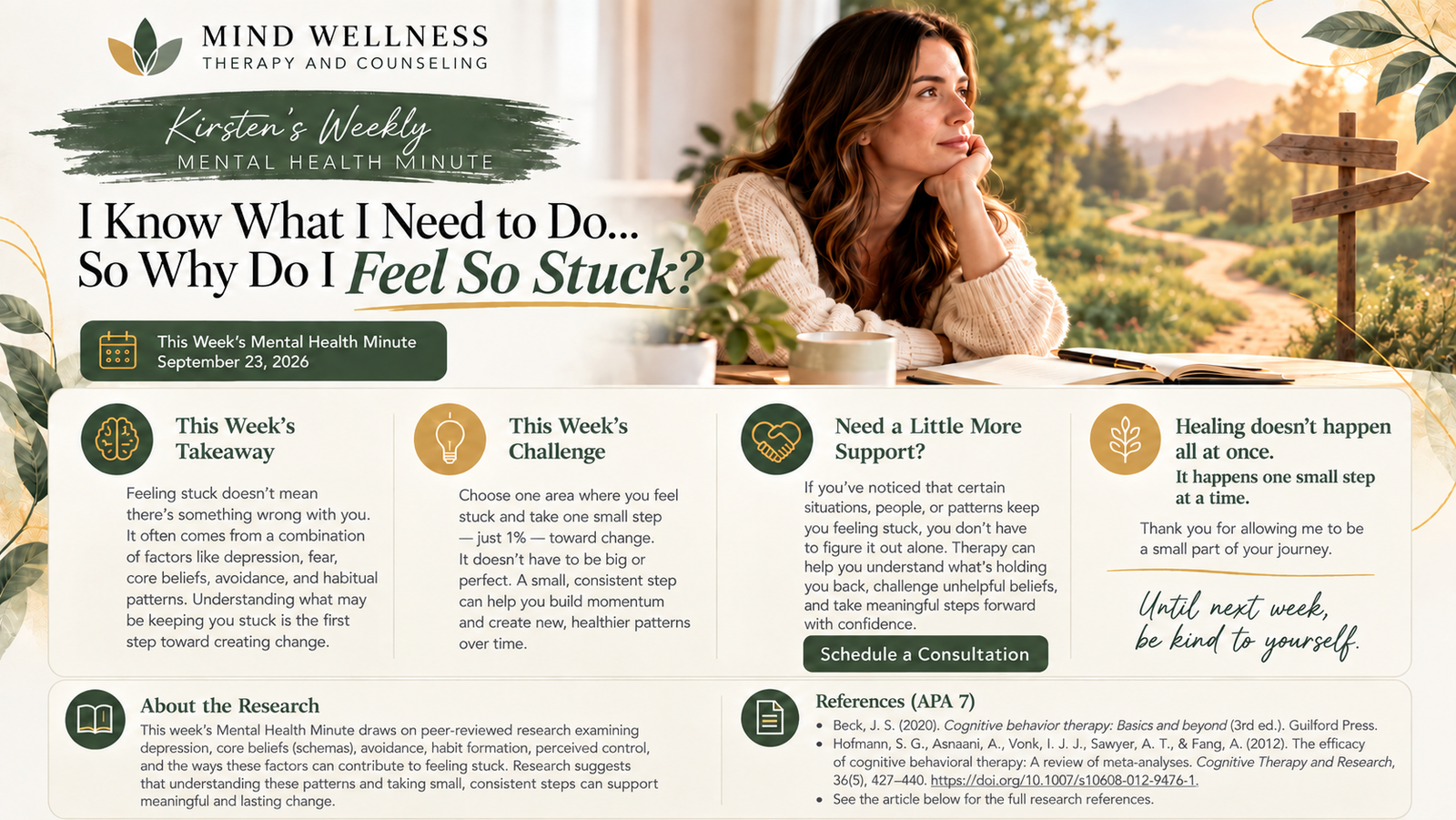
Kirsten’s Weekly Mental Health Minute
By Kirsten Woods · September 23, 2026 issue
Have you ever known exactly what you needed to do—but still couldn’t make yourself do it?
You know you need to make the phone call.
Start exercising.
Apply for the job.
Set the boundary.
End an unhealthy relationship.
Clean the house.
Or finally deal with something you’ve been avoiding for months.
You may even tell yourself:
“I know what I need to do. Why can’t I just do it?”
And eventually that frustration can turn inward:
“What’s wrong with me?”
But feeling stuck doesn’t necessarily mean you’re lazy, unmotivated, or unwilling to change.
Sometimes it’s depression.
Sometimes it’s fear.
Sometimes it’s an old belief about yourself.
And sometimes your brain has simply become very good at repeating a familiar pattern.
What Does It Mean to Feel Stuck?
Feeling stuck isn’t a diagnosis.
It’s an experience.
You might feel like you want something to change but can’t seem to move forward.
If you’re wondering, “Why do I feel stuck?”, there may not be one simple answer. Depression, fear, negative beliefs about yourself, avoidance, stress, familiar habits, or experiences that leave you feeling powerless can all play a role. Practical barriers—such as limited time, money, health, or support—can matter, too. Understanding what may be keeping you stuck is a first step toward choosing support and a manageable next action.
And here’s the frustrating part:
Knowing what needs to change and actually being able to change it are two very different things.
We often believe that if we understand the problem, we should automatically be able to fix it.
Unfortunately, our brains don’t always work that way.
Insight is important.
But insight alone doesn’t necessarily create change.
Could Depression Be Making You Feel Stuck?
Depression can affect much more than your mood.
It can affect energy, concentration, motivation, decision-making, pleasure and even how much effort your brain believes something will require.
Something that once felt simple can suddenly feel enormous.
Answering an email.
Taking a shower.
Going for a walk.
Cleaning the kitchen.
Making an appointment.
When you’re depressed, you may know perfectly well that doing these things would probably help.
But knowing that doesn’t necessarily make starting easier.
That’s an important distinction.
“I know I should” is not the same as “My brain and body are ready to do it.”
Depression is only one possible explanation; feeling stuck alone does not establish a diagnosis. For more on difficulty getting started, read Why Am I So Unmotivated?. If these struggles persist, therapy for depression can offer a place to explore what you’re experiencing.
Could a Belief Be Blocking You?
Sometimes what keeps us stuck isn’t only what is happening around us.
It’s what we’ve learned to believe about ourselves.
Psychologists often call these core beliefs or schemas.
They can sound like:
“I’m not good enough.”
“I’m going to fail anyway.”
“I don’t deserve better.”
“People will leave if I disappoint them.”
“I can’t handle this.”
“Nothing I do will make a difference.”
These beliefs don’t usually appear overnight.
They can develop through repeated experiences, relationships, criticism, rejection, failure, trauma or messages we received earlier in life.
Eventually, a belief can become so familiar that we stop questioning it.
It no longer feels like a belief.
It feels like a fact.
And if you believe something is impossible, dangerous or destined to fail, you may try to protect yourself from the discomfort you expect.
So you avoid.
You procrastinate.
You stay where you are.
And then something interesting happens.
How Avoidance Can Keep You Feeling Stuck
Imagine you want to apply for a new job.
A thought appears:
“I’m probably not qualified enough.”
That creates anxiety.
So you decide:
I’ll work on the application tomorrow.
For a moment, you feel better.
You avoided the uncomfortable feeling.
But tomorrow becomes next week.
Next week becomes next month.
Eventually you think:
“See? I never follow through with anything.”
And now the original belief becomes even stronger.
The cycle can look something like this:
Belief → Fear → Avoidance → Temporary relief → No change → Stronger belief → Feeling even more stuck
This is one reason avoidance can be so powerful.
It often makes us feel better right now while keeping us stuck long term.
This example describes avoiding a manageable task, not protecting yourself from genuine danger. If worry and avoidance are affecting daily life, counseling for anxiety may help you understand the pattern.
Why Do I Keep Repeating the Same Patterns?
Because familiar responses can become easier to repeat.
When we repeat behaviors often enough in similar situations, they can become more automatic.
This is useful.
Imagine having to consciously think through every step of brushing your teeth or driving your car every morning.
Habits save mental energy.
But we can also fall into patterns that aren’t particularly helpful.
Avoiding difficult conversations.
Procrastinating.
People-pleasing.
Shutting down.
Staying in unhealthy relationships.
Automatically saying yes.
Some laboratory research suggests that stress can favor habitual responses over flexible, goal-directed behavior. Later studies have found mixed results, so this is a possible influence rather than a rule about everyone’s brain.
So during the times when we most want to change, we may find ourselves returning to exactly what we’ve always done.
Not necessarily because it’s the best choice.
Because it’s the choice we already know.
Complex experiences, including remaining in an unhealthy relationship, can also involve safety concerns, financial dependence, or other real constraints. They cannot be explained by habit alone.
Why Do I Feel Trapped?
There’s another important piece: control.
When someone repeatedly experiences situations in which their actions don’t seem to change the outcome, they may begin to feel powerless.
Eventually the thought becomes:
“What’s the point?”
Why try?
Why apply?
Why speak up?
Why set the boundary?
Why change anything?
Research on helplessness and controllability explores how learning that actions can influence outcomes may support resilience. Much of the underlying neuroscience comes from animal studies, so it does not directly explain every person’s experience of feeling trapped.
Which brings us to something hopeful.
How to Get Unstuck
Usually not by changing our entire life overnight.
And not by waiting until we suddenly feel incredibly motivated.
Sometimes we begin by giving ourselves a different experience.
Instead of asking:
“How am I going to fix all of this?”
Try asking:
“What is one thing I can control today?”
Send one email.
Walk for five minutes.
Make one phone call.
Open the application.
Put your shoes on.
Say no once.
Clean one drawer.
Schedule the appointment.
Choose a step that is safe and realistic for your circumstances; asking for help can be that step.
Why does something so small matter?
Because you’re giving yourself new information:
“I can do something.”
“I have choices.”
“I can influence what happens next.”
One small action doesn’t solve everything.
But it can interrupt the cycle.
And sometimes that’s exactly where change begins.
This Week’s Takeaway
Feeling stuck doesn’t always mean you don’t know what to do.
Sometimes you know exactly what to do.
The problem may be depression, fear, an old belief, avoidance, a familiar habit—or a combination of several of them.
Instead of asking:
“What’s wrong with me?”
Try asking:
“What’s keeping me here?”
That’s a very different question.
And it may lead to a very different answer.
This Week’s Challenge: The 1% Rule
Think of one area of your life where you currently feel stuck.
Don’t try to solve the entire problem.
Instead, ask yourself:
“What am I telling myself about why I can’t move forward?”
Then ask:
“What is one small thing I could do today that would move me just 1% forward?”
Not 50%.
Not fixing your entire life.
Just 1%.
Then try that one thing—even if you don’t feel completely ready—as long as it is safe and manageable.
The “1% Rule” is a practical reflection exercise, not a measured treatment effect or a promise of a particular rate of improvement.
A Question to Reflect On
Think about an area where you’ve felt stuck for a long time.
Ask yourself:
“Is something truly preventing me from moving forward—or is there a belief, fear or familiar pattern telling me that I can’t?”
Sometimes both are present. Real barriers deserve support, not self-blame.
And then one more question:
“What might happen if I stopped waiting to feel ready?”
Frequently Asked Questions About Feeling Stuck
Why do I feel stuck even when I know what to do?
Knowing what needs to change does not automatically make action easy. Fear, low energy, avoidance, familiar habits, negative beliefs, or practical barriers may get in the way. Notice what happens just before you stop, and consider one safe, manageable step or a source of support.
Can depression make you feel stuck?
Yes. Depression can affect energy, concentration, enjoyment, and motivation, making everyday tasks harder to start. But feeling stuck alone does not mean you have depression. If the feeling persists or affects daily life, a qualified professional can help you explore possible causes.
Why do I keep repeating the same patterns?
Repeated responses can become familiar and automatic, especially in similar situations. Avoidance can also bring short-term relief that makes it tempting to repeat. Beliefs, relationships, stress, and real-life constraints may contribute; a recurring pattern is not a personal failure.
How can I start getting unstuck?
Choose one area and make the next step small, specific, and realistic: open the application, write the first sentence of an email, or ask someone for support. You do not have to solve everything at once. If a step feels overwhelming, make it smaller or seek help.
When should I talk to a therapist about feeling stuck?
Consider reaching out when feeling stuck is persistent, distressing, or interfering with work, relationships, self-care, or daily responsibilities. Therapy can help you understand patterns and explore options without assuming a diagnosis. If past experiences feel relevant, you can also read Is It Anxiety… or Are You Being Triggered?.
For more practical, compassionate mental health education, visit the Mental Health Minute Blog.
Need a Little More Support?
Sometimes we can identify what’s keeping us stuck on our own.
Other times, the pattern runs deeper.
Depression, trauma, anxiety, grief, negative core beliefs and experiences from our past can all influence how we see ourselves and the choices we believe are available to us.
Therapy can provide a safe place to understand those patterns, challenge beliefs that may no longer serve you, and begin practicing different ways of responding.
You don’t have to change everything today.
You just have to begin somewhere.
Mind Wellness Therapy & Counseling offers in-person therapy in Frisco, Texas, and online therapy for clients throughout Texas.
If you’re ready to take that first step, I’d be honored to walk alongside you.
Healing doesn’t happen all at once.
It happens one small step at a time.
Thank you for allowing me to be a small part of your journey.
Until next week, be kind to yourself.
About the Research
This week’s Mental Health Minute draws on research examining depression and motivation, behavioral activation, core beliefs, habits, stress, and perceived control. These studies offer possible ways to understand feeling stuck; they do not establish a diagnosis or a single explanation for every reader.
Behavioral Activation involves gradually reconnecting with meaningful activities. A 2020 Cochrane review found that it may help adults with depression, although the authors’ confidence in the findings was limited by the certainty of the evidence. A small-step exercise in a blog is not the same as individualized Behavioral Activation treatment.
Research on core beliefs describes associations between negative self-schemas and depression. Habit research explains how repeated responses in recurring contexts can become more automatic. An early laboratory study found that stress favored habitual responding, but later replication studies highlighted mixed evidence and measurement limitations. Research on controllability includes substantial animal work, so its application to an individual’s daily life requires care.
Together, this research helps us explore an experience many people know well: Sometimes we know exactly what we need to do—and still struggle to do it.
References
Baratta, M. V., Seligman, M. E. P., & Maier, S. F. (2023). From helplessness to controllability: Toward a neuroscience of resilience. Frontiers in Psychiatry, 14, 1170417. Read the review.
Beck, J. S. (2020). Cognitive behavior therapy: Basics and beyond (3rd ed.). Guilford Press. Publisher information.
Dozois, D. J. A., & Rnic, K. (2015). Core beliefs and self-schematic structure in depression. Current Opinion in Psychology, 4, 98–103. https://doi.org/10.1016/j.copsyc.2014.12.008
Grahek, I., Shenhav, A., Musslick, S., Krebs, R. M., & Koster, E. H. W. (2019). Motivation and cognitive control in depression. Neuroscience & Biobehavioral Reviews, 102, 371–381. https://doi.org/10.1016/j.neubiorev.2019.04.011
Hofmann, S. G., Asnaani, A., Vonk, I. J. J., Sawyer, A. T., & Fang, A. (2012). The efficacy of cognitive behavioral therapy: A review of meta-analyses. Cognitive Therapy and Research, 36(5), 427–440. https://doi.org/10.1007/s10608-012-9476-1
Schwabe, L., & Wolf, O. T. (2009). Stress prompts habit behavior in humans. Journal of Neuroscience, 29(22), 7191–7198. Read the study.
Smeets, T., Ashton, S. M., Roelands, S. J. A. A., & Quaedflieg, C. W. E. M. (2023). Does stress consistently favor habits over goal-directed behaviors? Data from two preregistered exact replication studies. Neurobiology of Stress, 23, 100528. Read the study abstract.
Uphoff, E., Ekers, D., Robertson, L., Dawson, S., Sanger, E., South, E., Samaan, Z., Richards, D., Meader, N., & Churchill, R. (2020). Behavioural activation therapy for depression in adults. Cochrane Database of Systematic Reviews, 2020(7), CD013305. Read the Cochrane review.
Wood, W., & Rünger, D. (2016). Psychology of habit. Annual Review of Psychology, 67, 289–314. https://doi.org/10.1146/annurev-psych-122414-033417
This article is intended for educational purposes and is not a substitute for individualized mental health care, diagnosis, or treatment.